

At a Glance
Physical AI describes the moment when AI makes the leap from software into the physical world — robots, drones, autonomous machines.
Three structural drivers are converging: falling hardware costs, maturing AI software, and growing demand for automation driven by ageing populations and reshoring.
The WisdomTree WPAI ETF (ISIN: IE000LCKJ888) captures this ecosystem across roughly 61 positions — from specialised robotics firms to AI infrastructure providers.
Access to hard-to-reach stocks: The ETF makes companies like Ubtech Robotics or Rainbow Robotics investable that are difficult to trade directly on European exchanges.
New to the market: Launched in February 2026 with no track record yet — a thematic investment for those with a corresponding time horizon.
This is Part 1 of 4 in our deep look at the WisdomTree Physical AI, Humanoids and Drones UCITS ETF (ISIN: IE000LCKJ888). This Spotlight covers the theme, the fund, and why it matters. In Parts 2–4, we go company by company — Ubtech Robotics, Rainbow Robotics, and Red Cat Holdings — to understand who’s actually building the machines. Subscribe for free so you don’t miss them.
The Next Wave Is Already Here
Ask ten people what they understand by artificial intelligence, and nine will talk about ChatGPT. About chatbots, image generators, voice assistants — software that lives behind a screen. But if you look closely, a shift is underway that goes considerably further.
In the factories of BYD and Foxconn in China, humanoid robots built by Ubtech are assembling components on production lines — not as an experiment, but in series production, around the clock. In January 2026, the company rolled its 1,000th Walker S2 off the production line at its Liuzhou plant, and orders for 2025 exceeded 1.4 billion yuan — roughly $200 million — ranking first globally among humanoid robot makers. Airbus has signed a cooperation agreement to deploy the Walker S2 in its aircraft manufacturing facilities. Automakers from Geely to FAW-Volkswagen to Audi are integrating these machines into their assembly lines.
Meanwhile, in the United States, autonomous drones built by Alphabet’s Wing are delivering Walmart orders from over 120 stores, with plans to expand to 270 locations by 2027 — making drone delivery available to more than 40 million Americans. The average fulfilment time: under 19 minutes. And Chinese automaker XPeng, through its subsidiary Aridge, has received over 7,000 preorders for its “Land Aircraft Carrier” — a modular electric vehicle with a detachable two-seat eVTOL that launches from the back of a minivan. Price tag: under $280,000. Deliveries are targeted for late 2026.
What’s happening here has a name: Physical AI. Artificial intelligence that no longer just processes data, but controls machines in the real world — in factories, warehouses, on farms, and in the airspace. According to Deloitte’s Tech Trends 2026 analysis, this development is reaching an inflection point this year: the transition from prototypes to commercial-scale production. NVIDIA CEO Jensen Huang put it more bluntly at CES: “The ChatGPT moment for physical AI is here.”
The Investment Thesis — and Why It’s Gaining Momentum Now
To understand why this theme is accelerating right now, it helps to look at the three drivers converging simultaneously.
First: the hardware is becoming affordable. Sensors, cameras, and the computing power needed for real-time decisions — so-called edge computing — have become dramatically cheaper in recent years. What cost a six-figure sum per robot five years ago is approaching price levels that make industrial mass production viable. Goldman Sachs reports that humanoid robot manufacturing costs dropped 40% between 2023 and 2024 alone, and the Bank of America projects material costs will fall further — from around $35,000 today to between $13,000 and $17,000 per unit within the next decade. Fanuc, the Japanese industrial robotics pioneer and one of the holdings in this ETF, exemplifies this shift with its CRX series of ultra-lightweight collaborative robots — compact enough for small workshops to deploy without specialised robotics expertise.
Second: the software is ready. The same AI models that generate text and recognise images can now also understand three-dimensional environments, navigate obstacles in real time, and control complex gripping motions. The bridge between “AI can think” and “AI can act” is being built — faster than many expected. Amazon’s recent acquisitions tell the story: the company acquired humanoid robot developer Fauna Robotics, and in March 2026, it purchased RIVR (formerly Swiss-Mile), a Zurich-based company building quadruped wheeled robots for autonomous delivery.
Third: the demand is structural. In Germany, Japan, South Korea, and large parts of Europe, populations are ageing faster than new workers are entering the labour force. At the same time, many companies are reshoring production back to their home markets. Both trends massively increase the demand for automation. When fewer people are available, machines have to step in. A Deloitte survey of over 3,200 global business leaders found that 58% are already using physical AI in their operations to some extent — and that figure rises to 80% when asked about plans over the next two years.
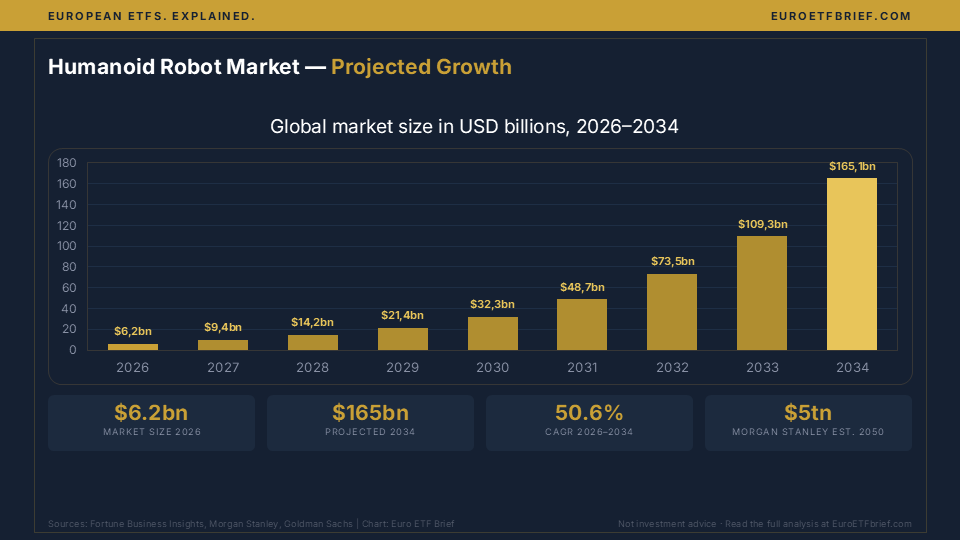
The numbers underline the trend: Goldman Sachs projects global humanoid robot shipments of 50,000 to 100,000 units in 2026. Morgan Stanley estimates the potential humanoid robot market at up to $5 trillion by 2050. The broader market is projected to grow from $6.2 billion in 2026 to over $165 billion by 2034 — a compound annual growth rate above 50%. In 2025 alone, $4.6 billion in venture capital flowed into humanoid robot developers.
Forecasts aren’t guarantees, of course. But they show that significant capital is flowing in this direction — not just from venture capitalists, but increasingly from industrial giants like Samsung, Hyundai, Amazon, and Foxconn.
From the Factory Floor to the Airspace — What Physical AI Looks Like in Practice
What makes Physical AI distinctive is that it’s not a single sector, but an entire ecosystem. To make this tangible, here are the five application areas that the index underlying this ETF also covers.
Humanoid robotics is the field attracting the most attention — and experiencing the fastest commercialisation. Ubtech Robotics, the ETF’s largest holding, has made the leap to series production with its Walker S2. The company collected orders worth over $200 million in 2025, supplying corporations from BYD and Foxconn to Airbus. Its annualised production capacity reached over 6,000 full-size humanoid units by end of 2025, with expectations of tens of thousands per year in 2026. The five global application scenarios Ubtech now covers — aviation manufacturing, vehicle manufacturing, 3C electronics, smart logistics, and semiconductor manufacturing — demonstrate how quickly the technology is finding real industrial use cases.
On the Korean side, Rainbow Robotics — one of the ETF’s top holdings — is developing the RB-Y1 humanoid for Samsung’s manufacturing lines, after Samsung became its largest shareholder with a 35% stake ($181 million) and established a dedicated Future Robotics Office reporting directly to the CEO. Samsung’s stated vision: humanoid robots and agentic AI reshaping its global factories by 2030.
Drones and autonomous mobility span from military reconnaissance to civilian parcel delivery. AeroVironment, also held in the ETF, operates under a $990 million framework contract with the U.S. Army for its Switchblade loitering munitions. In February 2026, the Army placed a $186 million order for the next-generation Switchblade 600 Block 2 — tank-killers small enough to fit in a backpack — followed by a separate $288 million delivery order. AeroVironment is scaling production from 40 systems per month to over 1,200, investing in a new next-generation manufacturing facility in Salt Lake City. On the civilian side, XPeng’s Aridge subsidiary is preparing to deliver its modular flying car from a 120,000 square-metre factory in Guangzhou, while Wing’s drone delivery network for Walmart is expanding coast to coast, targeting 40 million reachable Americans.
Smart factories form the backbone of the Physical AI revolution. This isn’t about individual robots, but about connecting entire production lines. Fanuc’s CRX series of collaborative robots exemplifies the trend: compact, lightweight, and designed so that even small businesses without robotics experience can deploy them — a critical step in scaling automation beyond large-scale industry.
Logistics robotics automates warehouses and supply chains. Autonomous drones scan inventory from above while ground robots sort and load packages — often in combination, orchestrated by central AI systems.
Emerging applications in agriculture, medicine, and defence round out the picture. From precision agricultural drones to robotic assistants in surgery — Physical AI is expanding into ever more domains.
Who’s Behind the ETF: WisdomTree
Before diving into the fund’s details, a brief look at the issuer. WisdomTree is a global ETF specialist headquartered in New York, with offices in London, Dublin, Milan, Munich, and Paris. In Europe, the firm manages over $50 billion in assets and has been active in the European market since 2014. Thematic ETFs are a core competency — WisdomTree develops proprietary indices and maintains an in-house research team that designs the thematic strategies.
Alexis Marinof, CEO Europe at WisdomTree, explains the rationale behind the launch: “Thematic ETFs are particularly effective at this point in a theme’s lifecycle, when the opportunity is broad, the winners are not yet obvious, and value is being created across an ecosystem.” Pierre Debru, Head of Research Europe, adds: “Physical AI is not a single industry but a fast-emerging ecosystem where intelligence is being embedded into machines that operate in the real economy.”
The ETF in Detail: WisdomTree Physical AI, Humanoids and Drones UCITS ETF
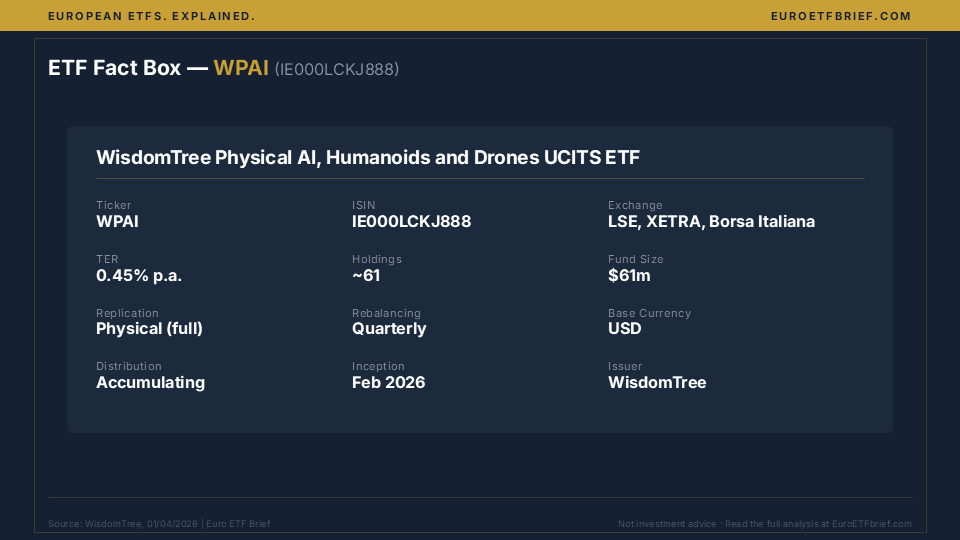
The WPAI launched on 10 February 2026 and physically replicates the proprietary WisdomTree Physical AI UCITS Index — meaning it actually purchases the stocks in the index, rather than tracking performance through derivatives.
How the index is constructed: WisdomTree divides the Physical AI universe into the five categories described above. Each category receives a Thematic Score from 1 to 3, reflecting its significance for the overall theme — humanoid robotics and drones are currently weighted higher than, say, logistics robotics. On top of that, each company receives a Relevancy Score measuring how closely its business model is tied to Physical AI. A company like Ubtech, which exclusively develops and sells humanoid robots, scores higher than a conglomerate where robotics is just one of many business lines.
The index is fundamentally equal-weighted and then adjusted through these two scores. Debru describes the design principle: “Our index construction process is specifically designed for environments like this” — fast-moving themes where the competitive landscape shifts rapidly. The composition is reviewed quarterly, and the portfolio currently holds roughly 61 positions.
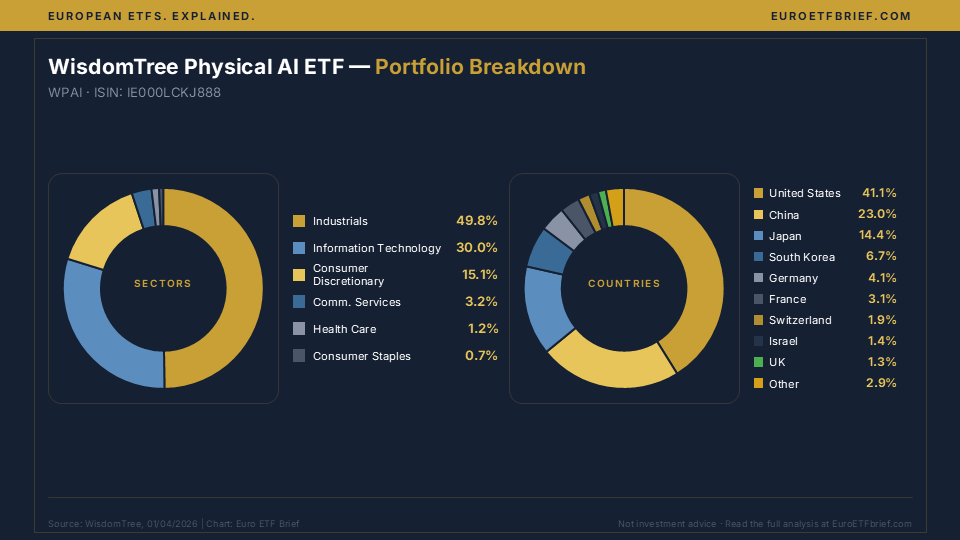
How does this differ from a standard AI ETF? If you already hold a broad AI or technology ETF, you’re mainly holding software companies and chipmakers — the “thinkers” of the AI revolution. The WPAI deliberately targets the other side: the companies that bring AI into the physical world. Half the portfolio (50%) consists of industrial companies — robotics firms, drone manufacturers, automation specialists. Information technology accounts for about 30%, and a further 15% falls under consumer discretionary, mainly through the automotive connection of Tesla and XPeng.
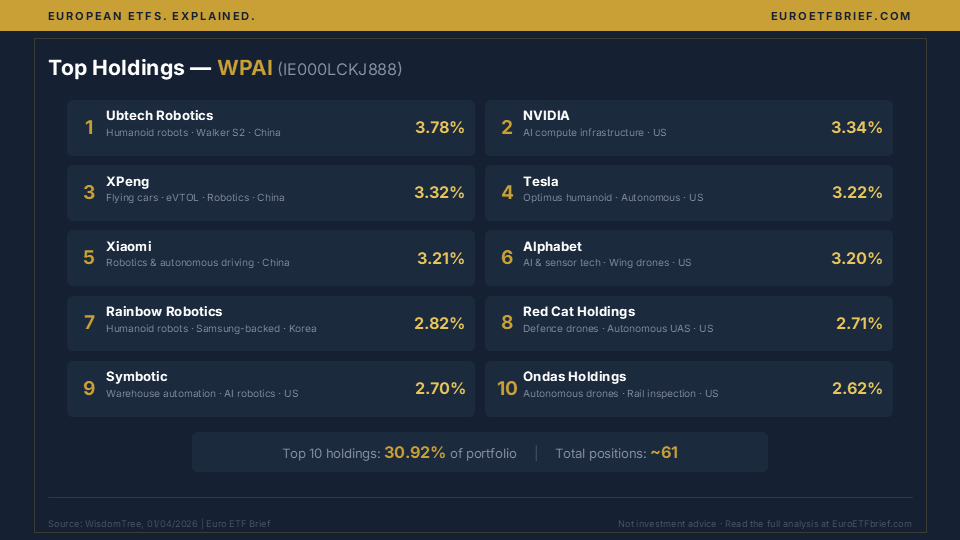
The holdings tell a story. Chinese Ubtech Robotics (3.78%) remains the portfolio’s largest position — not a mega-cap, but a specialised company developing and already mass-producing humanoid systems. NVIDIA (3.34%) has risen to second place, reflecting the critical role of AI compute infrastructure. XPeng (3.32%) follows closely, bridging autonomous vehicles and eVTOL aircraft. Tesla (3.22%) brings its Optimus humanoid and experience with autonomous systems, Xiaomi (3.21%) is investing heavily in robotics and autonomous driving, and Alphabet (3.20%) contributes its AI and sensor expertise. South Korean Rainbow Robotics (2.82%) rounds out the top names — Samsung became its largest shareholder at the end of 2024, investing $181 million for a 35% stake and establishing a dedicated robotics division.
Notable newcomers to the top 10 include Red Cat Holdings (2.71%), a defence drone specialist focused on autonomous unmanned aerial systems, and Symbotic (2.70%), which develops AI-powered warehouse automation robots. Ondas Holdings (2.62%) completes the top 10 with its autonomous drone and rail inspection technology.
This blend is what makes the fund distinctive: it deliberately overweights specialised pure-plays rather than relying on the usual tech heavyweights. The top 10 holdings account for just 30.92% of the portfolio — a notably even distribution. If you wanted to buy Ubtech or Rainbow Robotics individually, you’d likely encounter significant hurdles with most European brokers — the ETF makes such names accessible.
Geographically, the United States accounts for roughly 41% of the portfolio, followed by China (23%) and Japan (14%). South Korea contributes about 7%, Germany around 4%. The total Asia weighting exceeds 45%. This isn’t coincidental: Asia accounts for approximately 60% of all industrial robot installations worldwide. For anyone looking to invest in Physical AI, the region is unavoidable — and the ETF facilitates precisely this access, including to markets and stocks that are otherwise difficult to reach for European retail investors.
Opportunities and Risks
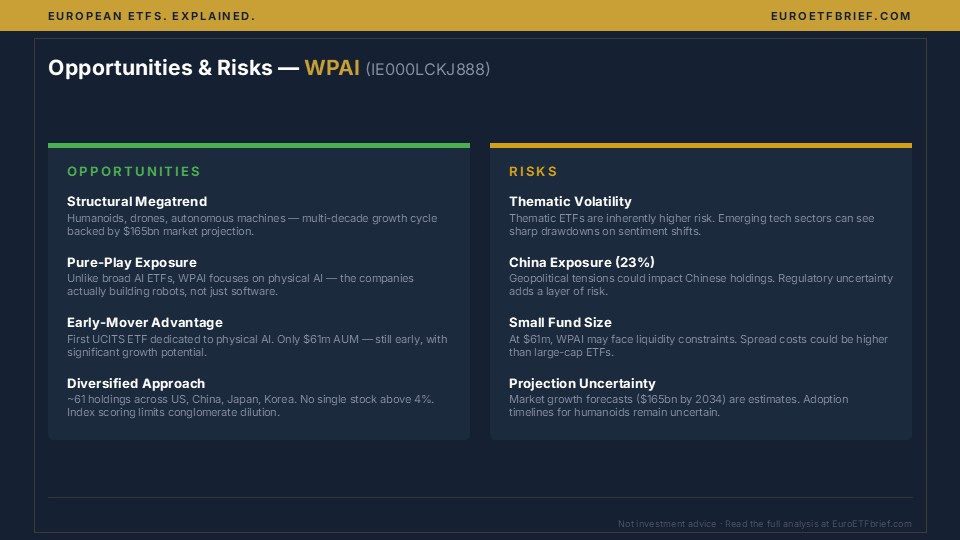
What speaks in favour of the thesis: Physical AI could be one of the defining structural megatrends of the coming years. The drivers — demographics, reshoring, falling hardware costs — are long-term in nature and unlikely to reverse quickly. The ETF provides diversified exposure across five clearly defined categories and makes stocks investable that are difficult to access directly on European exchanges. Physical replication ensures transparency, and quarterly rebalancing means the portfolio can keep pace with the sector’s rapid evolution. Unlike a broad AI ETF, this fund deliberately focuses on the physical implementation side — a complement, not a duplication.
What to keep in mind: The fund has only been on the market since February 2026 and consequently has no track record yet. As with any thematic investment, the trend could develop more slowly than expected — or today’s frontrunners may not be the long-term winners. Since the ETF is denominated in USD and has a substantial Asia weighting, currency and geopolitical factors come into play — though these are considerations that apply to most globally oriented equity ETFs. The high China exposure (23%) specifically warrants attention given ongoing trade tensions and regulatory uncertainty.
For investors who already hold a well-diversified core portfolio and are looking for a satellite position in a forward-looking theme, this could be one to explore.
Conclusion
AI is leaving the screen — and not at some point in the future, but now. Ubtech has rolled out its 1,000th Walker S2 humanoid and booked over $200 million in orders from BYD to Airbus. NVIDIA’s AI compute infrastructure is powering the brains behind these machines. Red Cat Holdings and Symbotic — newcomers to the ETF’s top positions — show how the theme is broadening from humanoids into defence drones and warehouse automation. Samsung has made a $181 million bet on Rainbow Robotics and built a dedicated robotics office reporting to the CEO.
The WisdomTree Physical AI, Humanoids and Drones UCITS ETF bundles these developments into a single investment vehicle — with the ambition of capturing not just the usual suspects, but the specialists who are actually building the machines. Whether the trend arrives as quickly and comprehensively as some forecasts suggest remains to be seen. But the fact that machines are learning to navigate our world — that’s already happening. For anyone interested in exploring this theme, this young fund could be worth a closer look.
Further Reading
Deloitte Tech Trends 2026: Physical AI and Humanoid Robots — Why 2026 could be the tipping point for Physical AI
Morgan Stanley: Humanoid Robot Market Expected to Reach $5 Trillion by 2050 — The long-term projection for the humanoid robotics market
Ubtech Walker S2 Begins Mass Production (PR Newswire) — The commercialisation of humanoid robots in practice
Samsung Becomes Largest Shareholder in Rainbow Robotics (Samsung Newsroom) — How major corporates are entering the robotics space
Wing and Walmart Expand Drone Delivery Coast to Coast (Wing) — The world’s largest drone delivery expansion
WisdomTree: WPAI Product Page — Official ETF information, factsheet, and KID
This Series: Company by Company Through the ETF
This Spotlight is just the beginning. In the next three parts (within the next few days), we go beyond the fund and into the companies themselves — examining the business models, financials, and risks of three of the ETF’s most distinctive holdings.
Part 2: Ubtech Robotics — From Prototype to Production
The ETF’s largest holding has shipped over 1,000 humanoid robots and signed partnerships from BYD to Airbus. We look at the numbers behind the Walker S2 and what a ~20x price-to-sales multiple is really paying for.
Part 3: Rainbow Robotics — The Samsung Catalyst
Samsung invested $181 million for a 35% controlling stake and built a dedicated robotics office around this Korean cobot maker. At nearly 475x trailing sales, the market is pricing in a future that hasn’t arrived yet.
Part 4: Red Cat Holdings — The Rearmament Tailwind
From the U.S. Army’s Short Range Reconnaissance programme to NATO’s approved catalogue, this defence drone specialist is scaling fast on the back of a geopolitical shift.
Don’t miss the rest of the series. Subscribe to Euro ETF Brief — it’s free — and Parts 2–4 will land in your inbox as they publish.
Disclaimer: This article does not constitute investment advice, a recommendation, or a solicitation to buy or sell any securities. The information contained herein is for educational and informational purposes only and does not replace individual advice from a qualified financial advisor. All investments carry risk, and the value of investments can fluctuate. Your capital is at risk, and past performance is not a reliable indicator of future results. While we strive to ensure the accuracy of the information provided, we make no representations or warranties regarding its completeness or accuracy. Disclosure: The author holds positions in the ETFs or securities mentioned.