

This is Part 2 of 4 in our deep look at the WisdomTree Physical AI, Humanoids and Drones UCITS ETF (ISIN: IE000LCKJ888). In Part 1, we covered the theme, the fund, and why it matters. Here, we go inside the ETF’s largest holding. Subscribe for free so you don’t miss the rest.

From Prototype to Production
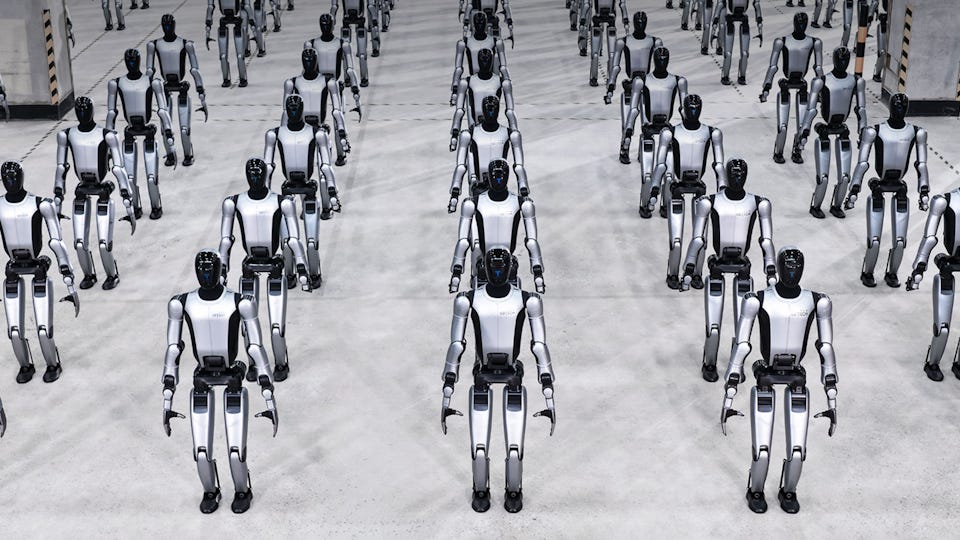
In December 2025, Ubtech rolled its 1,000th Walker S2 humanoid robot off the production line at its factory in Liuzhou, southern China. Not a prototype. Not a demo unit for a trade show. A production robot, destined for a factory floor — one of over a thousand shipped to clients ranging from BYD to Airbus. Two months later, in March 2026, Ubtech signed a strategic partnership with Siemens to scale production to 10,000 units per year by 2027. While most humanoid robot companies are still iterating on prototypes, Ubtech is iterating on production capacity.
What They Do
Ubtech Robotics, founded in 2012 by Zhou Jian in Shenzhen, started life building consumer and educational robots — small humanoids like the Alpha series that could dance, interact, and teach kids to code. That origin story matters, because it gave the company a decade of experience in bipedal locomotion, sensor fusion, and AI integration before the industrial opportunity arrived.
Today, the business has pivoted decisively toward industrial humanoid robots. The flagship Walker S2 is a full-size humanoid designed for factory work: it navigates production lines, handles components, performs quality inspections, and operates autonomously around the clock. The company now covers five industrial application scenarios — aviation manufacturing (Airbus), vehicle manufacturing (BYD, Geely, FAW-Volkswagen, Audi), 3C electronics (Foxconn), smart logistics (SF Express), and semiconductor manufacturing (Texas Instruments).
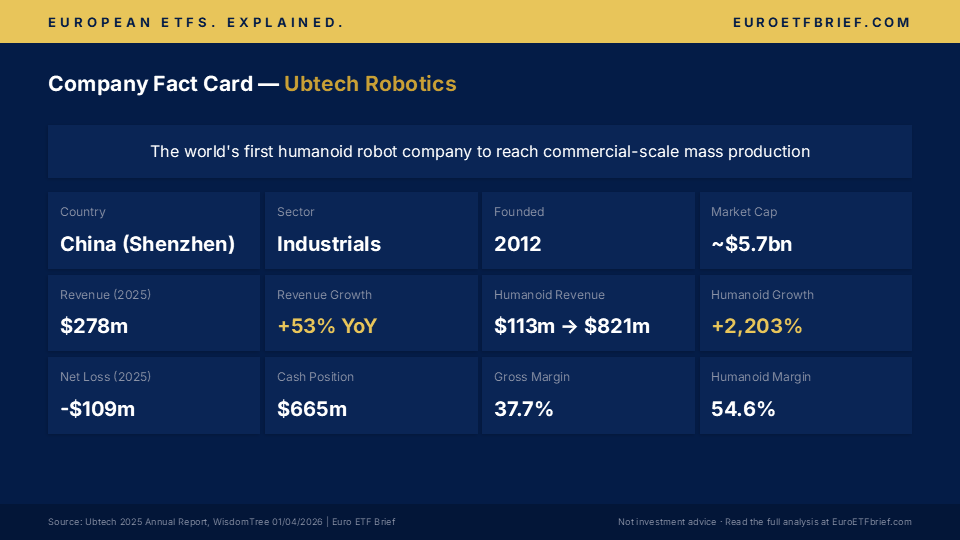
The 2025 annual results tell the story of a company in full transformation. Total revenue reached RMB 2.01 billion ($278 million), up 53% year-on-year. But the headline number is the humanoid segment: revenue from full-size humanoid robots surged from RMB 35.6 million in 2024 to RMB 821 million — a 2,203% increase. Humanoids now account for 41% of total revenue, making it Ubtech’s largest business line for the first time. The segment’s gross margin sits at an impressive 54.6%. Cumulative orders for the Walker series exceeded RMB 1.4 billion ($200 million) in 2025, ranking Ubtech first globally among humanoid robot makers by commercial orders.
The company is not yet profitable — it reported a net loss of RMB 789.8 million in 2025 — but that loss narrowed by 32% from the prior year, and Ubtech is sitting on RMB 4.82 billion in cash. Listed on the Hong Kong Stock Exchange since December 2023 (the first humanoid robot company to list there), its market capitalisation currently sits at around HK$45 billion (~$5.7 billion). Trading at roughly 20× sales, the market has clearly priced in significant future growth — which means the stock needs to keep delivering on those production ramp-up targets to justify its valuation.
Beyond the Walker S2, Ubtech also develops automated logistics solutions — including the Chitu series of L4-level (fully autonomous in controlled environments) driverless logistics vehicles and heavy-load automated forklifts — giving it a broader automation portfolio beyond humanoids.
Why It Matters for the ETF Theme
At 3.78%, Ubtech is the largest holding in the WisdomTree Physical AI, Humanoids and Drones UCITS ETF — and it’s there for a reason. The ETF’s index is designed to overweight companies with high “relevancy scores,” meaning those whose core business is directly tied to the Physical AI theme. Ubtech is about as pure-play as it gets: humanoid robots and industrial automation are not a side project or a division within a conglomerate. They are the entire business.
Ubtech represents the humanoid robotics category that sits at the heart of the ETF’s investment thesis — the idea that AI is moving from software into machines that operate in the physical world. Where companies like NVIDIA (the ETF’s second-largest holding at 3.34%) provide the computational brains, Ubtech is building the body. Its Walker S2 is among the first humanoid robots to make the leap from prototype to commercial-scale production, which is precisely the inflection point the ETF is designed to capture.
Because the index weights companies by thematic relevancy rather than market capitalisation, Ubtech’s pure-play status helps ensure it remains a top allocation — though its weight is subject to the ETF’s standard quarterly rebalancing and capping rules, so it won’t drift unchecked.
There’s also a practical access argument. Ubtech trades on the Hong Kong Stock Exchange (9880.HK), which most European retail brokers don’t offer or charge premium fees to access. For investors who want exposure to the company, the WPAI ETF is one of the most straightforward ways to get it — no foreign exchange account or specialist broker required.
The company’s client list also underlines the breadth of the theme. When the same robot platform is deployed across automotive (BYD), aerospace (Airbus), electronics (Foxconn), and semiconductors (Texas Instruments), it signals that the demand for physical AI isn’t confined to one industry — it’s structural.
Risks & Considerations
Ubtech is still loss-making, and while the trajectory is improving, profitability remains some way off. Because the stock commands a premium growth multiple, the valuation leaves little room for disappointment.
The geopolitical dimension deserves particular attention. Ubtech is a Chinese AI and robotics company at a time when the US has imposed escalating export controls on advanced AI chips — the very components humanoid robots rely on for real-time decision-making. The precedents are uncomfortable: Huawei was placed on the US Entity List, DJI drones have been banned from US government use, and similar restrictions could conceivably extend to Chinese robotics firms operating in sensitive industries like aerospace and semiconductors. Ubtech’s revenue is heavily concentrated in China today, but its ambitions — and client list (Airbus, for example) — are global. Any tightening of Western technology restrictions or allied procurement bans could constrain both its supply chain and its expansion into non-Chinese markets.
The Walker S2 dominates its revenue, creating a degree of single-product dependency: if demand plateaus or a competitor leapfrogs the technology, the impact would be significant. Competition is intensifying — Tesla’s Optimus, Unitree’s lower-cost G1 (priced at roughly $13,500 versus the Walker S2’s estimated $90,000–$150,000 depending on configuration and volume), Figure AI, and Agility Robotics are all vying for the same market. And the broader humanoid robot industry remains early-stage; the gap between ambitious production targets and sustained commercial demand is real.
Conclusion
Ubtech Robotics is no longer a company promising to build humanoid robots — it’s a company shipping them, at scale, to some of the world’s largest manufacturers. As the largest holding in WPAI at 3.78%, it illustrates the ETF’s deliberate tilt toward specialised pure-play companies that are turning Physical AI from concept into commercial reality. Whether the humanoid robotics market grows as fast as the most ambitious forecasts suggest remains an open question. But for anyone following this theme, Ubtech is the name that has moved furthest from the lab to the factory floor.
This Series: Company by Company Through the ETF
Part 1: ETF Spotlight — When AI Learns to Walk
The full analysis of the WisdomTree Physical AI, Humanoids and Drones UCITS ETF — the theme, the index, the holdings, and the risks.
Part 3: Rainbow Robotics — The Samsung Catalyst
Samsung invested $181 million for a 35% controlling stake and built a dedicated robotics office around this Korean cobot maker. At nearly 475x trailing sales, the market is pricing in a future that hasn’t arrived yet.
Part 4: Red Cat Holdings — The Rearmament Tailwind
From the U.S. Army’s Short Range Reconnaissance programme to NATO’s approved catalogue, this defence drone specialist is scaling fast on the back of a geopolitical shift.
Don’t miss the rest of the series. Subscribe to Euro ETF Brief — it’s free — and all parts will land in your inbox as they publish.
Sources
Ubtech 2025 Financials: Humanoids Leap to Centre Stage (Humanoids Daily)
Ubtech 2025 Report Card: Humanoid Revenue Grows Over 22-Fold (Gasgoo)
Ubtech Partners with Siemens for Mass Production (CnTechPost)
Disclaimer: This article does not constitute investment advice, a recommendation, or a solicitation to buy or sell any securities. The information contained herein is for educational and informational purposes only and does not replace individual advice from a qualified financial advisor. All investments carry risk, and the value of investments can fluctuate. Your capital is at risk, and past performance is not a reliable indicator of future results. While we strive to ensure the accuracy of the information provided, we make no representations or warranties regarding its completeness or accuracy. Disclosure: The author holds positions in the ETFs or securities mentioned.